 English
 Indian
 العربية
 Español
 Deutsch
 Türkçe
 Русский
 Français (Afrique)

Valve working on Steam Frame strap that adds Index-like speakers and hot-swappable batteries, 'coming soon'
The Valve Index might be outdated in many ways today, but it still holds a special place in my heart for its excellent audio solution: twin speakers that deliver impressive spatial properties without actually touching your ears. The Steam Frame doesn't take the same approach, sadly, but word from Valve is that it's working on a first-party accessory that'll add a set of Index-like speakers to the compact Frame.
The Steam Frame is modular. Three small switches are all it takes to completely remove the core module, containing the chip, RAM, storage, optics and more, from the strap. The strap also includes the battery, SD card slot, and speakers.
"So the battery, the thermals; I think those will be the ultimate limits of the device," said Jeremy Selan, software engineer at Valve during a pre-launch chat. "We thought of that early. It's no surprise. So that's why we were very proud of making a modular design where the core module is separate from the rear. grenadier.co.za
"And in fact, you might say, 'Hey, what is Valve going to do with this?' We're working on a future first-party accessory where it will plug in and replace the existing [strap]. That head strap will include a hot-swappable battery, and then premium Index-style off-ear audio."
When pushed for a date as to when this accessory might be available, Selan joked that he was one of the people who was confident that the Steam Frame would land in early '26, and no longer felt like a credible source on these things. Fair enough. He ended up saying, "we're working to make it available as soon as we can."
"The Valve Index audio is, I mean, it's awesome, and so we wanted to give people the opportunity to have that," says Joy Lyons, hardware engineer and audio expert at Valve. "And so it's a modular design. You just snap in, like Jeremy mentioned. That's not available at launch, but it's coming soon, and we'll have pricing and details on that."

The Steam Frame's speaker system is totally serviceable, anyways. I've been using the headset for three weeks and I've no complaints in that specific department. Lyons explained how this solution ended up being implemented.
"One of the design principles for the headset is being lightweight and also being portable, so you can collapse it. And so having any additional structure in the headband, that was something where early on it was clear, hey, that's going to interfere with our ability to collapse it and take it with you. And so we elected to put the audio into the head strap."

Lyons explained how they decided on two drivers on either side of the headset, but that these ended up pretty close to the core module. The core module contains all the camera and sensors for the Frame's inside-out tracking, which makes it very sensitive to vibration.
"The vibration caused the screen to jump with the bass, which is not as exciting as it sounds," Lyons said.
"So we were able to, with that early architecture, flip one of the drivers, and so the sound's coming out in phase. So you're getting your double sound output per side, but the vibration's been cancelled. And so we wanted to have this open-ear experience, so that really gives you that sense of immersion; you're not closed in, you're not hot, and it just builds a very natural sound."
YouTuber gets classic Tomb Raider running on a chip that sips a mere 1 W of power
Modern PC gaming may not be the most energy efficient hobby. Even as someone who would sooner play yesteryear's favourite over this month's shiniest new game, I dread to think just how much smaller my electricity bill might be if it wasn't for my gaming rig. Thankfully for retro gaming fiends, energy efficient hardware isn't hard to come by.
Case in point, hardware creator Alejandro Villegas Alonso shared a clip of classic Tomb Raider running from a low-power chip. The SoC in question is the ESP32-P4 microcontroller, a lightweight 32-bit RISC-V processor featuring two 400 MHz cores which sips a mere 1 watt of energy according to the data sheet (via Tom's Hardware).
It's not the kind of chip that would usually be used for anything like gaming, rather more for simple tasks in embedded devices such as cameras—that makes it all the more impressive that Alonso has got Tomb Raider up and running on it. It's particularly appealing given you can pick one of these up for very little cash.

The chip is running a port of OpenLara, a version of the original Tomb Raider that can be played in your browser with unlocked FPS. This version recreates the classic game in an open source engine so, no, this isn't a teeny tiny original PlayStation emulator or anything like that. Alejandro Villegas Alonso explains via the project's GitHub that this port "runs the classic Tomb Raider 1 engine with software rendering, audio, and USB HID keyboard input on Espressif's latest RISC-V SoC."
The project uses the ESP32-P4-Function-EV-Board specifically, which comes with both a seven-inch capacitive touch screen and even a camera module. This obviously pushes the project's total power budget a little higher than 1W, with the power use of even just the 1024 x 600 LCD screen quickly overshadowing what's being used by the chip at this board's heart.
Alonso writes that their Tomb Raider port features a "software RGB565 renderer at 320 x 240, hardware-scaled to 1024 x 600 via the [...] Pixel Processing Accelerator." As Croft crunches through snow in the YouTube short, you can hear stereo audio via an ES8311 codec. Game inputs are handled via a USB keyboard, though that feels borderline profane to a console interloper like me.
With some versions of this development board costing a little under $30, it's not hard to see why ESP32 microcontrollers are such a popular choice for DIY hardware projects. Recently, we've seen similar SoCs used in a credit card sized computer, the 'world's worst USB drive', plus this pocket-sized Game Boy emulator based on an ereader. Creativity knows no bounds, but I wouldn't be surprised if we saw a few more retro gamers begin to bring yesteryear's favourites back to life on similarly low-power hardware.
Valve’s Steam Frame VR headset opens for orders, with the cheapest model priced at a lenswatering £889 / $1,059
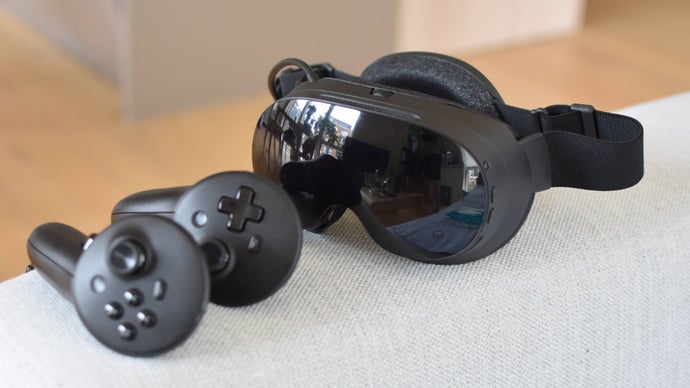
Valve have just launched the Steam Frame wireless VR headset, finally completing the triumvirate of new hardware – along with the new Steam Machine and Steam Controller – that they unveiled all the way back in November 2025. The review embargo has also lifted, meaning I can tell you that it’s a smart and flexible piece of virtual reality kit. Definitely the most versatile of its kind, in terms of how it lets you play games.
Less triumphantly, the Frame has clearly sustained the impact of the same memory shortages and component cost explosions that jacked up the Machine’s pricing and limited its stock. Thus, despite initial plans to make the Frame cheaper than the ultra-premium Valve Index, the Steam Frame starts at £889 / $1,059 / €1,049 for the smaller 256GB model. That rises to £1,089 / $1,299 / €1,279 for the top 1TB version, with several accessory options potentially bumping out the outlay even further.